
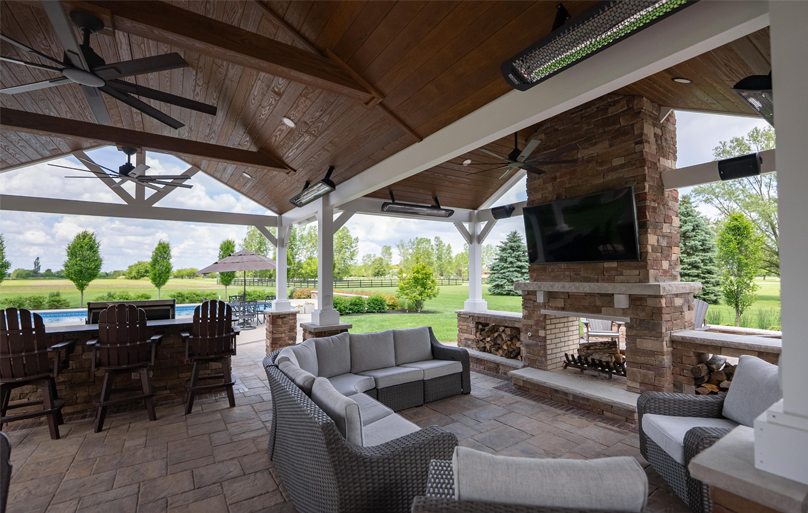
The most memorable homes do not end at the back door. They continue outward across a threshold to a terrace that feels as intentional as a living room, along pathways that unfold naturally from the architecture, and into gardens and outdoor spaces that feel as composed and thoughtfully designed as any interior gathering space.
In Central Ohio’s most established communities, from Upper Arlington and Bexley to New Albany, Dublin, and Worthington, the finest outdoor environments share a common quality. They feel like a natural extension of the home, and that sense of continuity is never accidental.
“The most successful outdoor spaces are designed as part of the home. When architecture and landscape are considered together, the result feels seamless and far more enduring.” — Shawn Rine, CEO, Rine Landscape Group
Where the Home Transitions Outdoors
Designing outdoor spaces that feel connected begins at the point of transition. Doors, thresholds, and sightlines all influence how the experience unfolds. When these elements are thoughtfully considered, movement between indoors and outdoors feels effortless. When they are not, the landscape feels like a separate environment rather than a continuation of the home.
Subtle decisions define this experience:
Aligning patios and terraces with interior floor elevations
Extending architectural lines into outdoor structures and hardscapes
Framing views from interior spaces toward focal points in the landscape
Creating clear and intuitive circulation between outdoor areas
The goal is not simply to create access to the outdoors. It is a seamless flow.
Materials That Create Continuity
Materials play a quiet but powerful role in connecting the home to the landscape. Natural stone that reflects the tones of the home’s exterior, along with wood elements that echo interior finishes to create surfaces that feel substantial and enduring rather than purely decorative.
In Central Ohio’s climate, material selection must balance aesthetics with performance. Freeze-thaw cycles, moisture, and seasonal variation all influence how materials age. When selected with care, the right grade of materials do more than complement the home; they mature alongside it.
Outdoor Rooms with Purpose
The most successful outdoor spaces balance feature and function. An outdoor dining area feels grounded and intimate when it is scaled to the home and oriented to how the homeowners live. A seating space anchored by a fire feature draws people together naturally. A quiet garden retreat offers privacy and reflection. Each space serves a distinct purpose, much like the rooms inside the home.
Designing outdoor rooms requires thoughtful consideration of:
Scale and proportion relative to the home
Orientation to sun, shade, and prevailing winds
Privacy from neighboring properties
Proximity to interior spaces and natural gathering areas
When these elements are aligned, outdoor spaces feel intentional rather than added.
Landscape Lighting Extends the Experience
As the day transitions into evening, lighting becomes essential. The most refined landscape lighting is rarely obvious. It is layered, subtle, and designed to support both the architecture and the experience of the space.
Lighting should:
Define pathways and transitions
Highlight architectural features and specimen plantings
Create warmth in gathering spaces
Maintain balance rather than over-illumination
When executed well, lighting allows outdoor spaces to feel elevated and complete long after the sun has set. On estate properties, lighting is one of the details that separates a landscape that is simply maintained from one that is truly stewarded.
Stewardship Begins with Vision
Creating a seamless connection between the home and the landscape is not a one-time effort. It requires ongoing care. Plantings mature, materials weather and outdoor spaces evolve. Like the interiors they extend, outdoor living spaces require attentive stewardship to remain at their best.
A thoughtful residential estate management process ensures that:
Plantings remain in proportion to the architecture
Materials age gracefully and are maintained properly
Outdoor spaces continue to function as intended
Seasonal changes are managed with intention
Without this level of care, even the best-designed outdoor living spaces begin to drift, losing clarity and connection to the home.
Creating a Unified Living Environment
At Rine Landscape Group, we believe the most successful properties are those where the distinction between indoors and outdoors becomes almost invisible. Design, construction, and ongoing stewardship all contribute to this outcome. Each decision supports a larger vision, and every detail works in harmony with the home. Because the most exceptional landscapes do not compete with the home. They complete it.
Rine Landscape Group distinguishes itself by prioritizing quality, artistry, and exclusivity. Our approach to residential estate design and management provides the level of care discerning clients in Bexley, Dublin, New Albany, Upper Arlington, Grandview, Worthington, and other Columbus communities expect, creating outdoor environments that feel composed from the outset and grow more beautiful with time.